
How to Respond to Food Comments at Holiday Meals
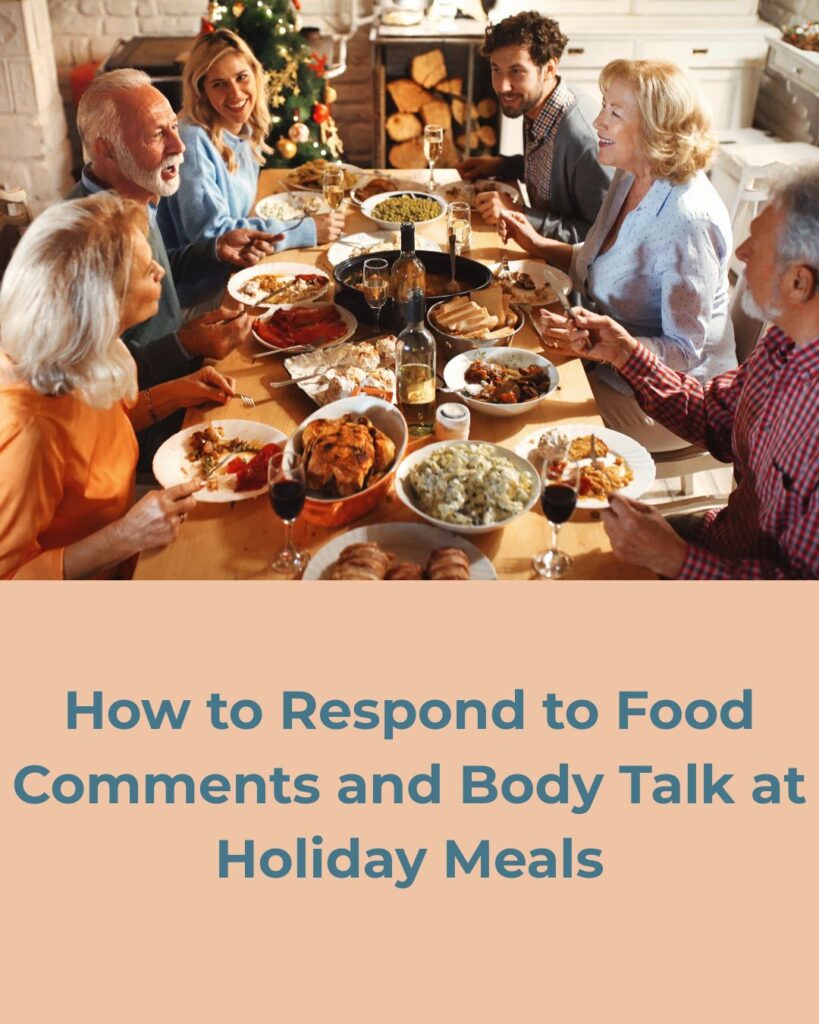
The holidays bring so much joy- familiar smells, warm kitchens, people you love- but they can also bring something a lot of us secretly dread:
food comments.
The subtle remarks.
The body talk.
The observations about what’s on your plate – or what “should” be.
If you’ve ever walked into a holiday meal already bracing yourself, you’re not alone. Food comments can feel incredibly personal, even when people don’t mean them to be.
A Holiday Moment That Caught Me Off Guard
Several years ago, I sat down at a holiday table with a slice of warm, gooey chocolate cake. I hadn’t stopped moving all day, and this was the first moment I allowed myself to just be — to savor something comforting and familiar.
I took one bite, and someone (that didn’t know me very well) across the table smiled and said:
“Wow, I didn’t think dietitians ate desserts.”
It was meant as a joke.
But like many food comments, it hit me in a tender place.
In an instant, I felt myself fold inward- that subtle, old urge to defend myself, make light of it, or prove that yes, dietitians eat dessert, yes, I’m still “healthy,” yes, I do like to eat delicious food.
It wasn’t about the chocolate cake.
It was about the assumption underneath it- the idea that my worth or credibility could be measured by what I put on my plate.And this is exactly why food comments at holiday meals can sting:
They seem light on the surface, but they land somewhere deeper inside us.
Why Food Comments Hurt (Even When You Know They’re Not About You)
Food comments, even the “innocent” ones can reopen old wounds:
- the part of you that learned to perform “good eating”
- the part of you that wanted family approval
- the part that was told your body was up for discussion
- the part that associated food with judgment or comparison
- the part that still carries diet culture’s rules in your nervous system
This is why food comments can make your shoulders tense or your appetite vanish.
Your body remembers long before your brain catches up.
There is nothing wrong with you for feeling it.
What Food Comments Are Really About
Here’s the compassionate truth:
Most food comments aren’t actually about your food choices.
They’re about:
- the other person’s food guilt
- their fear of “losing control”
- their own history with dieting
- their discomfort with pleasure or satisfaction
- their beliefs about “good” and “bad” foods
- their comparison mindset
- their longing to feel in control during a chaotic season
Their comment is a window into their story, not a reflection of yours.
You don’t have to carry it.
How to Respond to Food Comments (Without Explaining Yourself)
Here are a few grounded, compassionate responses that protect your peace:
- “I’m good, thanks.”
- “I’m listening to what my body wants today.”
- “Let’s talk about something else.”
- “I prefer not to comment on food or bodies.”
- “My plate and I are good — promise.” (lighthearted)
You don’t owe anyone justification for your hunger, your appetite, or your body.
How to Stay Grounded in the Moment
When a food comment hits especially unexpectedly try one of these gentle tools:
1. Feel your feet on the floor.
This brings you back into your body.
2. Take one slow breath.
It creates space between the comment and your reaction.
3. Name the moment internally.
“This is touching an old place.”
“This feels familiar.”
Naming reduces the emotional charge.
4. Come back to your plate.
What do I want right now?
What feels good to me?
5. Return to your values.
Compassion. Permission. Satisfaction. Presence.
Not performance.
If the Food Comment Stays With You Later… That’s Normal
Many people think the hard part is the comment itself, but often, the real sting shows up later:
In the car.
In the shower.
When the house is finally quiet.
If you find yourself replaying the moment, try saying:
- “Of course that felt tender.”
- “Anyone would react that way.”
- “That comment wasn’t mine to hold.”
- “I stayed with myself — and that matters.”
Your healing is not measured by your ability to stay unbothered.
It’s measured by how gently you come back to yourself.
A Holiday Wish for You
My hope is that this year, you walk into your holiday table with:
- a sense of calm
- permission to enjoy your food
- confidence in your boundaries
- compassion for yourself
- and the reminder that food comments are never a reflection of your worth
You deserve connection and comfort.
You deserve satisfaction.
You deserve to take up space without apology.
💛 If You Need Support Navigating Food Comments This Season…
You don’t have to do this work alone.
I help teens and adults heal their relationship with food using a compassionate, non-diet approach — especially during moments when food comments and body talk feel overwhelming.
If you’re craving more peace, more trust in your body, and more support this holiday season, I’d love to help.