2026 Dietary Guidelines: A Non-Diet Perspective
The 2026 Dietary Guidelines were recently released, and with them came a familiar mix of headlines, opinions, and confusion. As a non-diet dietitian, I’m less interested in debating whether the guidelines are “right” or “wrong,” and more interested in how they land in real people’s lives — especially for those who have spent years trying to eat “correctly.” Because nutrition guidance doesn’t just shape what we eat; it shapes how we relate to food.
In my work, I sit with people every day who are trying to “eat better” and end up feeling more confused, discouraged, or disconnected from their bodies. That lived experience is what informs how I read the guidelines — not just as a dietitian, but as someone who cares deeply about helping people build a more peaceful, sustainable relationship with food.
What’s New in the 2026 Dietary Guidelines
1. A Shift Back to a Food Pyramid–Style Model
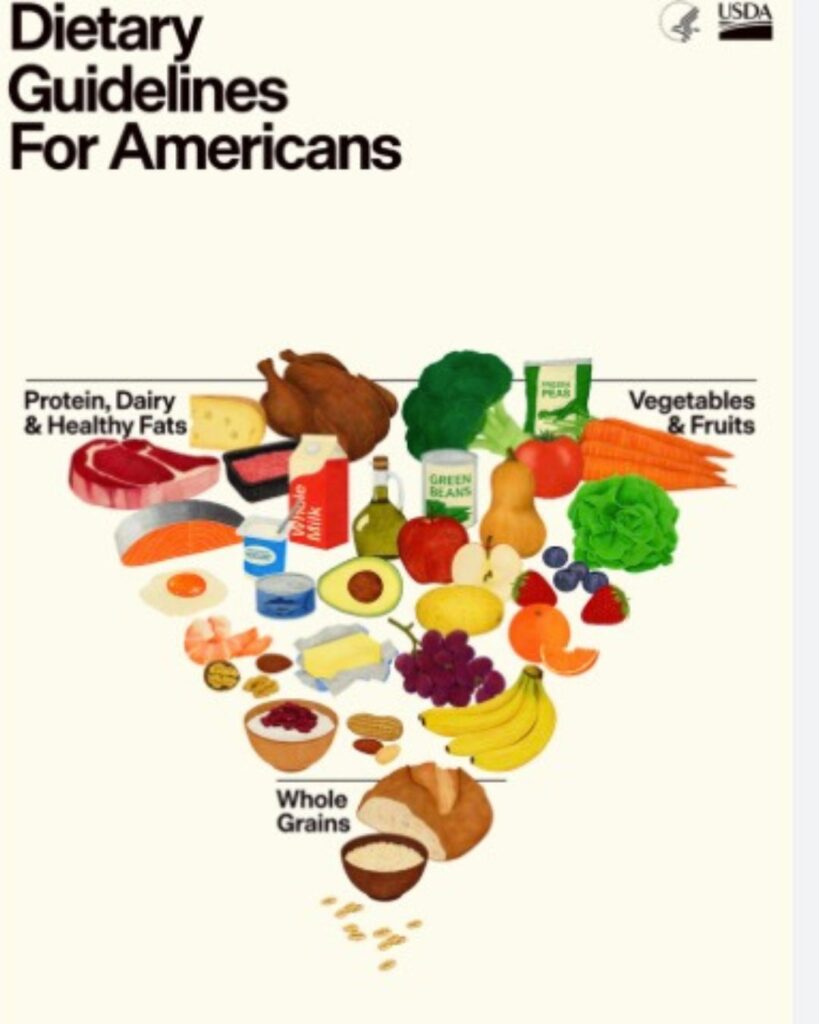
One of the most visible updates is the move away from MyPlate and toward a reimagined food pyramid.
- Protein-rich foods and fats are positioned near the top
- Grains and carbohydrates appear lower in the visual hierarchy
- The design suggests prioritization rather than balance
While intended as a simplified visual, this structure can easily be interpreted as:
“Eat more of what’s on top and less of what’s on the bottom.”
This marks a notable departure from prior messaging that emphasized proportional balance across food groups.
2. Increased Emphasis on Protein — Especially Animal Sources
The 2026 Dietary Guidelines place greater emphasis on protein intake across the lifespan, particularly highlighting:
- Meat and poultry
- Eggs
- Dairy (including full-fat options)
Protein is framed as essential for muscle maintenance, metabolic health, and aging populations — a message grounded in valid physiological concerns.
However, plant-based proteins (beans, lentils, tofu, nuts, seeds) receive far less visual emphasis, despite strong evidence supporting their role in heart health and longevity.
3. Saturated Fat Guidance Remains — But Messaging Is Mixed
In written form, the 2026 Dietary Guidelines continue to recommend:
- Limiting saturated fat to less than 10% of daily calories
Yet visually, foods higher in saturated fat (such as red meat, cheese, butter, and full-fat dairy) are featured prominently in the pyramid.
This disconnect between text-based recommendations and visual messaging has created confusion — even among nutrition professionals — about moderation versus prioritization.
4. Continued Focus on Reducing Added Sugars and Ultra-Processed Foods
The guidelines reaffirm recommendations to:
- Limit added sugars
- Reduce intake of highly processed foods
Ultra-processed foods are linked to increased chronic disease risk, and the guidance continues to promote:
- Whole foods
- Minimally processed options
- Nutrient adequacy across life stages
This aspect of the 2026 Dietary Guidelines reflects long-standing public health consensus.
5. A Stronger Emphasis on Disease Prevention
As in previous cycles, the 2026 Dietary Guidelines frame nutrition largely as a tool for:
- Reducing chronic disease risk
- Managing cardiovascular health
- Supporting metabolic outcomes
While prevention matters, this lens can unintentionally narrow the conversation about food to risk avoidance, rather than nourishment, enjoyment, or sustainability.
What Often Gets Lost in How the 2026 Dietary Guidelines Are Experienced
1. Guidelines Shape Beliefs — Not Just Eating Patterns
Nutrition guidance doesn’t just affect food choices. It shapes belief systems.
When foods are placed into visual hierarchies, many people internalize messages like:
- Some foods are morally “better”
- Eating well equals self-control
- Health is earned through discipline
In practice, I see how quickly public health messaging becomes self-judgment, especially for people with a history of dieting, food rules, or disordered eating.
Non-diet lens:
Guidelines that ignore psychological impact are incomplete.
2. Population Guidelines Become Personal Rules
The 2026 Dietary Guidelines are designed for populations — not individuals — yet they’re often absorbed as personal mandates.
This is how we end up with thoughts like:
- “I shouldn’t eat this.”
- “I failed today.”
- “I need to start over.”
When broad guidance becomes rigid self-rules, it can undermine flexibility, body trust, and long-term consistency.
3. What’s Missing: Satisfaction, Pleasure, and Enoughness
One of the biggest omissions in the 2026 Dietary Guidelines is any meaningful discussion of:
- Enjoyment
- Satisfaction
- Cultural and emotional connection to food
Food is framed primarily as fuel and disease prevention — not as something meant to be enjoyed or trusted.
And yet, satisfaction plays a key role in:
- Appetite regulation
- Reducing overeating
- Building a sustainable relationship with food
When satisfaction is ignored, people often swing between over-control and disengagement.
4. Weight Remains the Silent Outcome Metric
Even though the 2026 Dietary Guidelines don’t explicitly promote weight loss, many people interpret them as implying:
“If I eat this way, my body should change.”
When bodies don’t respond predictably, people blame themselves rather than questioning the framework.
From a weight-inclusive perspective:
- Health behaviors don’t guarantee weight outcomes
- Bodies respond differently to the same inputs
- Weight is not a reliable indicator of health
Important reminder:
Health is not a reward for perfect eating.
How to Engage With the 2026 Dietary Guidelines More Gently
The 2026 Dietary Guidelines can be useful at a systems level — but they’re not a rulebook or a moral standard.
A more supportive approach asks:
- Does this way of eating support my energy and well-being?
- Does it allow flexibility and pleasure?
- Does it respect my body, history, and life context?
Nutrition becomes most helpful when information is paired with curiosity, compassion, and adaptability, not surveillance.
Final Thought
The most important question isn’t whether the 2026 Dietary Guidelines are good or bad.
It’s whether they help people build a sustainable, respectful relationship with food — or quietly reinforce fear, control, and perfectionism.
That’s the conversation I believe is most needed.
If you are struggling with your relationship with food and want more support, I’d love to see if we’d be a good fit for each other. Reach out to me here to set up a discovery call.
To stay up to date on my blogs related to intuitive eating, non diet approach and body image, subscribe to my Substack!